
Rewiring the system to accelerate impact at scale: How IDIA is redesigning the architecture of development innovation
Editor’s note: This is the final instalment of a three-part blog on how the insights, tools and models pioneered by members of the International Development Innovation Alliance (IDIA) are helping agencies “Meet the Moment” of scaling in the new world order. Part one explored the fundamentals of developing or refreshing a scaling strategy, including key frameworks and insights curated by the IDIA ecosystem. Part two looked at the practice of scaling through an ecosystem lens, highlighting IDIA’s widely adopted “Mountain Model” for public sector scaling. This concluding piece looks at partnership-based approaches to scaling, and provides insight into the soft launch of two exciting new initiatives IDIA is implementing to transform innovation financing and institutional capacity.
What is the best approach to creating significant, sustainable impact from innovation?
This was the core question when a group of eleven development agencies established the International Development Innovation Alliance (IDIA) in 2015. IDIA is a platform for collaborative learning, experimentation and thought leadership that has become the world’s principal network dedicated to this topic. While our understanding of what works has advanced leaps and bounds, it has become increasingly clear that no single “best approach” exists for translating innovation into impact. Rather, people have tended to fall into (or flex between) one of two camps. Some prioritize making the scaling process faster and more efficient so that more innovations can reach more people. Others focus on influencing changing the wider social, political, technical, institutional, and policy environment (the ‘system’), noting that the this is the necessary foundation for scaling impact that lasts.
Increasingly, however, we’ve learned that neither approach is sufficient on its own. The real challenge is building partnerships that can bridge them both.
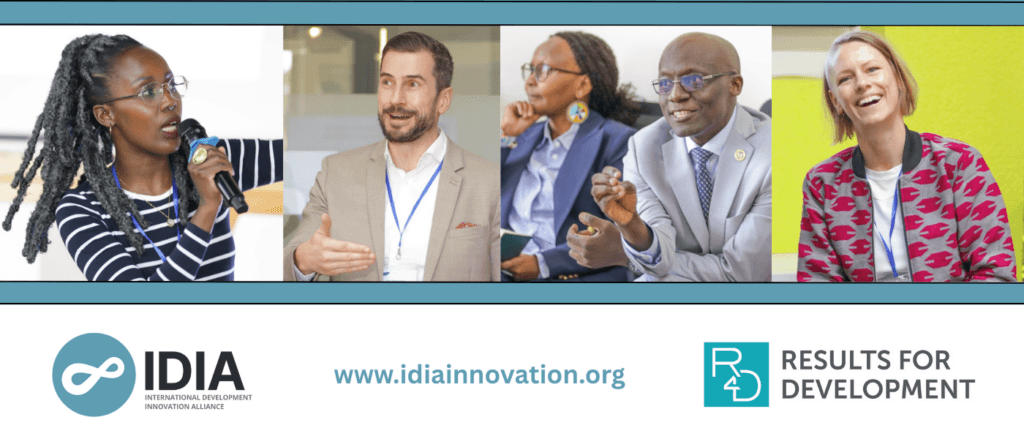
That conclusion was reinforced at IDIA’s Partnerships for Scale convening in May — which brought together members of our Investors & Enablers Community for two days of cross-pollination and co-creation — where participants recognized that ‘scaling and systems change have to go hand in hand’.
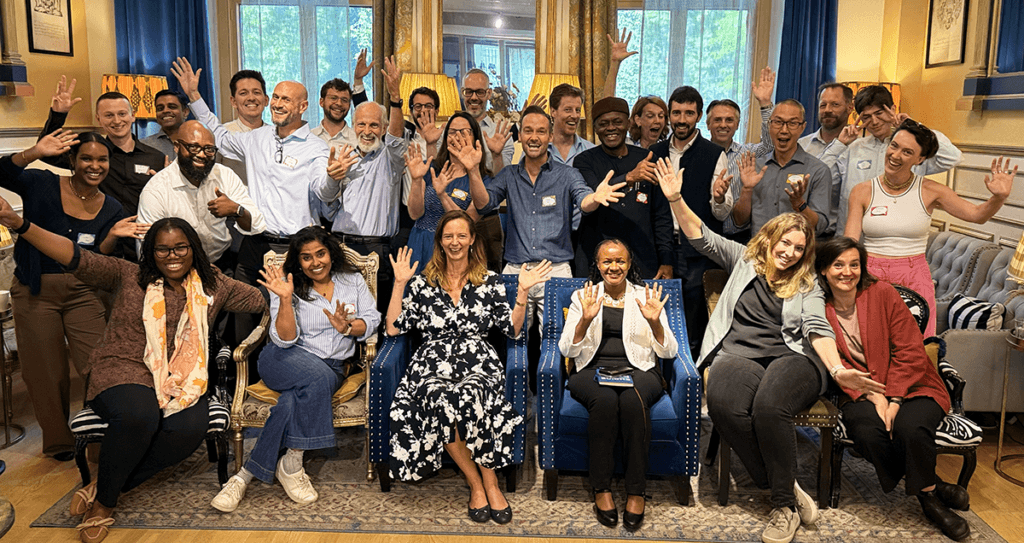
Participants at IDIA’s Partnerships for Scale convening.
This is simple enough to understand, but enormously difficult to put into practice. As Larry Cooley, co-founder of the Global Scaling Community of Practice (an IDIA Partner Network) noted in his presentation, most development agencies are now grappling with a fundamental misalignment between their ambition, culture and incentives (which are commonly oriented towards systems change) and their rigid institutional structures, short-term funding instruments and political governance models. And these institutional tensions are more apparent than ever in today’s environment of diminishing development budgets and limited organizational capacity.
It was precisely for this reason that participants from 24 agencies within the IDIA ecosystem — including private foundations, bilateral and multilateral agencies, innovators, government innovation leaders, researchers and other network facilitators — came together to share, learn from, and co-create new forms of partnership that embrace scaling and systems change.
Several promising ideas emerged, including a potential outcomes-based financing facility that enables industry, government and development partners to invest according to their particular incentives and priorities; new coalitions enabling data interoperability and the bundling of solutions from across different agencies; the creation of Innovation Market Value Chain Maps to accelerate the research to commercialization process; and public-private collaborations bringing industry experts and government ministries together to reimagine skills training and job pathways for entrepreneurial youth.
The convening also marked the launch of two initiatives that put these ideas into action:
1. The IDIA Capital Continuum — a concept to transform innovation financing
Development innovators play a critical role in advancing global prosperity. They create new jobs, introduce lifesaving technologies, and drive locally rooted, place-based solutions to global challenges. But for too many, the pathway to sustainable impact remains uncertain. Funding often arrives too late, in the wrong form, or not at all. And when capital is available, it can be mismatched to the realities of growing a business in complex, underdeveloped and fast-changing markets.
At present, the channels through which financial capital is made available to innovators for scaling are siloed and insufficient to provide a smooth, coherent pathway of support. The burden sits largely on the innovator to research the different types and levels of financing available — a challenge made harder by fragmented information, inconsistent language and terminology, and limited transparency around investment criteria. Access to funding can also depend heavily on existing relationships, while scarce capital is often concentrated among a relatively small group of innovators, making it difficult for new entrants to break through.
Global development funder also require extensive application forms and due diligence processes that often demand significant time and repetitive effort on the part of the innovator. Even when awards are finally determined, the complexities of the contracting process on both sides can add many more months, meaning it often takes 6–12 months between application and the start of funding.
To address this problem, IDIA is working with initial sponsorship from GIZ to scope and test a new, two-pronged approach to enhancing how innovators and entrepreneurs can access and arrange different types of capital for transformative social impact. Rather than focusing on individual funding instruments, the approach aims to improve how capital is deployed across the innovation journey — strengthening coordination among funders while helping innovators access the right capital at the right time.
A ‘Capital Continuum’ is a structured approach through which various types of capital are sequenced and connected within a coherent structure or suite of mechanisms to provide a smoother, faster pathway to impact. It focuses on improving coordination across the funder community — making it easier for investors to align their contributions, refer innovators between funding opportunities, and create a more connected pathway through the different stages of scaling.
The second component focuses on the innovator rather than the funder. It helps innovators assemble the right combination—or “Capital Stack” —of funding types and sources for their stage of growth. As innovations mature or increase in complexity, they often need different types of capital to support different stages of their development. The right mix depends on both the innovation and the sector in which it operates. Each sector has different market dynamics, timelines to impact, revenue models, regulatory landscapes and levels of perceived risk. For example, agricultural innovations often rely on government subsidies, cooperatives, and blended finance because of the risks associated with seasonal cash flows and climate exposure. Health care innovations, by contrast, tend to depend more heavily on patient, long-term capital because they operate in a highly regulated environment.
Together, the Capital Continuum and the Capital Stack demonstrate that blended instruments alone are not enough. Achieving impact at scale requires a more coordinated approach to deploying capital — one that aligns funders while helping innovators access the right mix of financing at each stage of their journey.
To learn more and explore how the IDIA Capital Continuum initiative can support your work, visit https://www.idiainnovation.org/capital-continuum
2. OASIS — an open space for AI tools, code and learnings in the development sector
In 2014, the World Bank reported that 31% of the reports they put online had “never been downloaded, ever, by anyone.” International development organizations publish tens of thousands of documents every year, and most practitioners only have time to read a tiny fraction of what’s relevant to their work. As a result, valuable evidence often goes unused.
Artificial intelligence (AI) has the potential to change that. While many organizations are already using AI to speed up individual tasks, there is still much to learn about how to adopt these tools in ways that improve organizational workflows, strengthen collaboration, design and manage for impact, save costs and support better decision-making across institutions.
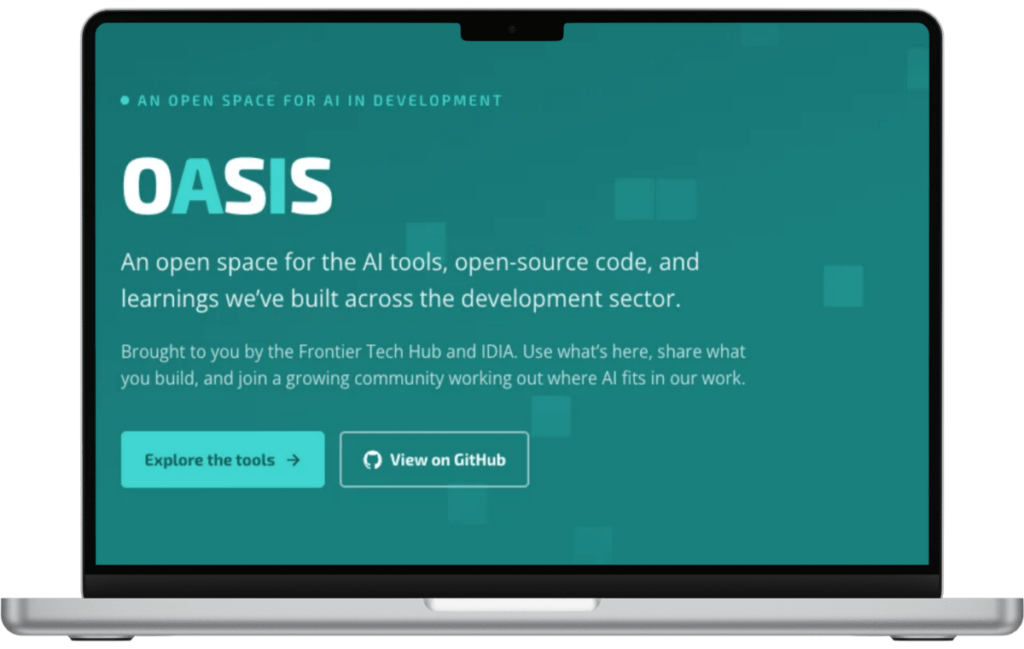
To explore that opportunity, IDIA is collaborating with the Frontier Technologies Hub to develop the OASIS Community — a collection of open-source AI tools, code and learnings designed for (and with) international development partners and practitioners. Soft-launched at the recent IDIA convening, OASIS provides a trusted environment where users can discover already developed AI tools, connect these existing tools with their own reports and data, bring new tools to the space, understand the code behind the tools and get access to customized support to meet their organization’s needs. OASIS is deliberately designed to be a Community where users can share experiences, learn from one another, contribute new ideas, collaborate and feel a sense of togetherness through the messiness and complexity of a facing moving AI-driven world.
At present, the OASIS platform includes the following tools:
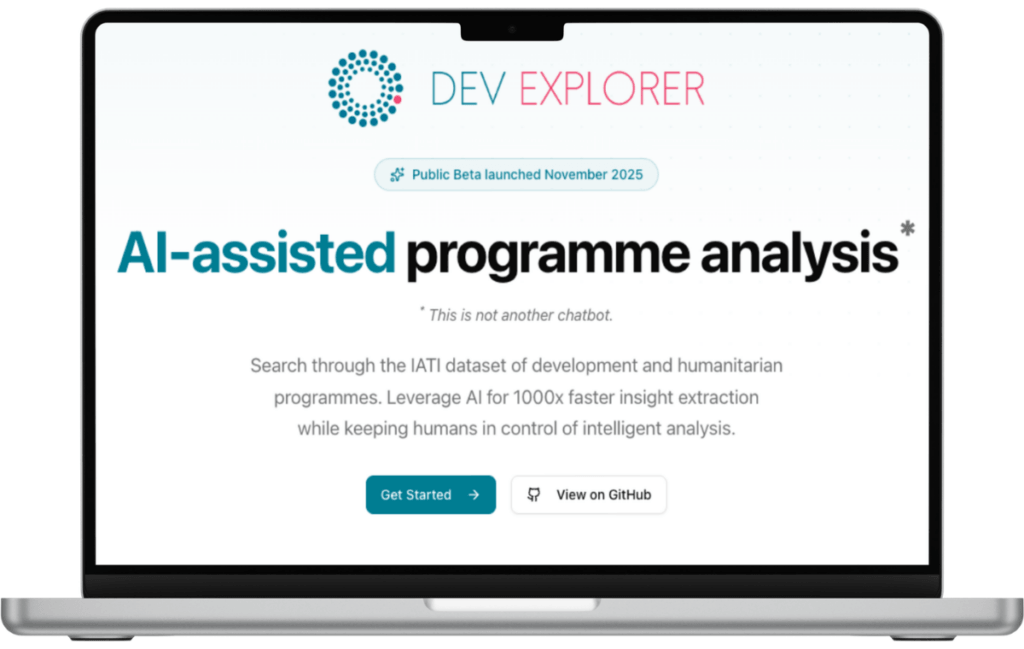
- DevExplorer: A tool for exploring development and humanitarian programs across the International Aid Transparency Initiative (IATI) repository, currently in beta testing
- EvalExplorer: A tool that analyses 20 years of evaluation reports, turning dense PDFs into structured, searchable, traceable evidence that helps users compare interventions and synthesize lessons across portfolios, currently in public alpha testing
- Transport Global Intelligence System (TGIS): A tool that makes the world’s transport data easier to access and analyze
Additional tools are already in development. Organizations can commission for the development of new tools, which the Frontier Tech Hub can build — for example, an AI-enabled political economy analysis tool has recently been proposed — or submit existing tools for review and potential inclusion in the OASIS Community.
To learn more and explore how the OASIS Toolkit can support your work, visit the OASIS Toolkit, visit https://www.idiainnovation.org/oasis-toolkit
In conclusion
“We have successfully matured the conversation from ‘what is scaling?’ to ‘what are the institutional, financial and partnership architectures that sustain it?’ This is a meaningful and significant shift, and one that IDIA is well positioned to anchor.”
“In today’s world, many people focus on the bad news and what is not possible. We need to protect and nurture our sense of ambition in this environment, and accept that this can generate positive outcomes and useful impacts at multiple levels across different actors, whether conceptual or practical.”
— Participants at IDIA Investors & Enablers meeting, London, May 2026
These reflections, shared by both long-time and first-time members of IDIA, provide a fitting conclusion to this three-part blog series on how IDIA is ‘Meeting the Moment’ of international development. Collaborative initiatives such as the IDIA Capital Continuum and OASIS Toolkit offer just a glimpse of how IDIA is working to translate innovation into impact and build a fairer, more inclusive, and sustainable world. Together, they illustrate how we are blending approaches that support the scaling of innovation with transformative system change.
Drawing on the expertise, commitment, and resources of partners across the IDIA ecosystem, these collaborations point to what is possible when organizations learn, experiment, and act together.
That is why I remain optimistic about the future of development innovation and invite others to join us in translating innovation into impact at scale.
If your agency is interested in joining the IDIA ecosystem, please contact us to check availability and alignment.