
Inside Ghana’s Free Primary Health Care reform: What it takes to design system change
A behind-the-scenes look at how government leaders translated a bold policy commitment into a practical implementation plan, with lessons for countries pursuing universal health coverage.
Ghana took a bold step toward universal health coverage in April 2026, when President John Mahama launched Free Primary Health Care (FPHC). This pronouncement signaled his commitment to implement his campaign promise to remove user fees at the primary care level for all residents, regardless of enrollment in the National Health Insurance Scheme. FPHC aims to address Ghana’s high out-of-pocket burden and low service coverage. In 2023, out-of-pocket payments accounted for approximately 25 percent of current health expenditure, underscoring the financial barriers that many households still face when seeking care. At the same time, Ghana’s UHC service coverage index — a measure of access to essential health services — stood at 56, substantially below the country’s target of 80 by 2030.
Behind the launch of FPHC were months of intensive design and planning to connect many pieces into a workable blueprint: defining the FPHC service package, estimating the cost of the package, determining the provider payment mechanism, equipping existing facilities to be prepared to deliver the package, ensuring the functioning of new points of service access, and preparing communities and primary care workers.
The design phase for a major health initiative like this is where the foundations to succeed are built – or where gaps accumulate that undermine implementation later.
This blog describes how the Ministry of Health, Ghana Health Service, and National Health Insurance Authority worked to establish a technically rigorous and feasible foundation for Free PHC, with technical support from R4D.
The two pillars of Ghana’s Free Primary Health Care reform: service delivery and financing
Ghana’s vision has two connected parts. The first is a service delivery reform: strengthening traditional primary care service delivery points such as Community-based Health Planning and Services (CHPS) compounds, health centers, and polyclinics, and widening access through newer points of access, including school clinics, community pharmacies, and health posts in densely populated areas.
The second is a financing reform that makes primary care free at the point of use and introduces a new population-based payment for providers. Primary care providers will receive fixed payments up front to deliver preventive and promotive services to a defined population, while payments for curative services will be made after claims are submitted through the existing Ghana-Diagnostic Related Groups (G-DRGs).
How Ghana designed the service delivery model for Free Primary Health Care
To translate President Mahama’s vision into a concrete plan, the Ministry of Health (MoH) developed a policy framework to set the overarching direction and priorities. Eight technical sub-committees contributed to the framework, with R4D providing technical input on two.
Next, the design process focused on developing a single implementation document to guide every actor in the health system, from the MoH to frontline CHPS workers.
The Ghana Health Service — through its Policy, Planning, Monitoring and Evaluation Division — led the development of the National Implementation Guidelines with R4D providing technical support. Those guidelines set out how the reform would work across service delivery, financing, human resources, digital health, community engagement, and governance.
With GHS leadership input, including the Director-General, the guidelines were expanded beyond a GHS-only lens, to reflect the roles of all service providers and institutions involved in FPHC implementation.
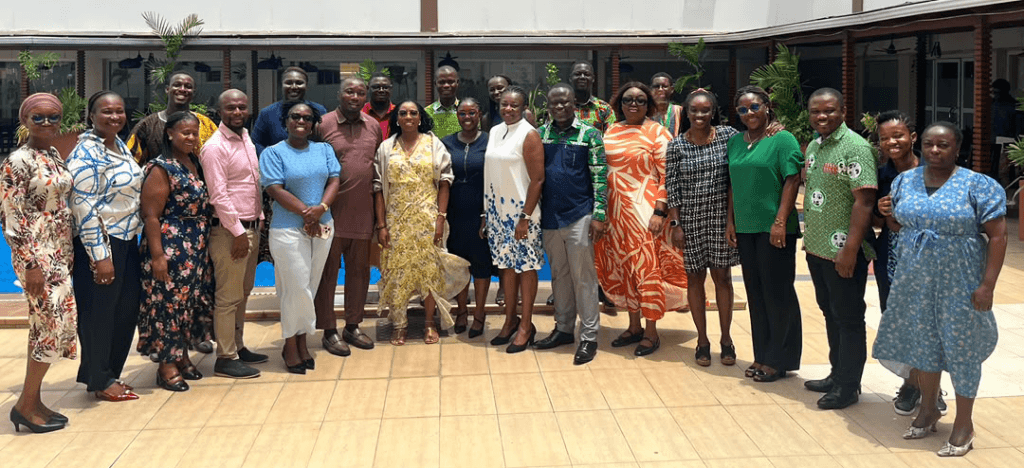
Participants in the R4D-supported technical workshop on Implementation Guidelines for Free Primary Health Care.
How Ghana designed the financing model for Free Primary Health Care
Planning for free primary health care began with two fundamental questions. What will it cost to deliver free primary health care nationwide? And how should providers be paid in a way that is sustainable and fair?
R4D co-led a Technical Working Group (TWG) with the National Health Insurance Authority to address these core financing design questions. The group included the Ghana Health Service, the Christian Health Association of Ghana, academia, WHO representatives, and the Ministry of Finance.
The TWG developed detailed cost estimates for a comprehensive primary health care package at national scale. This work built on costing analysis R4D had earlier developed with the Ghana Health Service, which defined and costed a 68-service Health Preventive and Promotive Benefits Package (HPPBP). It then modeled three service delivery scenarios: (1) a CHPS-compounds-only scenario, (2) a scenario adding health centers; and (3) a scenario extending further to polyclinics. This gave decision-makers a range of costed options and made the fiscal implications of different design choices visible.
Different viewpoints emerged within the TWG on how best to structure provider payment for primary care going forward. These discussions reflected the difficult tradeoffs involved in moving from one payment model to another. Any change creates uncertainty and financial risk for both providers and payers, and what may be technically preferable is not always politically feasible, particularly when reforms create potential “winners and losers.”
As a technical partner, R4D provided unbiased evidence and honest advice to strengthen the government’s decision-making. Sometimes, this meant raising concerns or highlighting the difficulty of changing course down the line. But R4D’s facilitative and neutral approach reflected what embedded technical partnership looks like in practice, with government retaining authority over final decisions.
Ultimately, the government selected a mixed payment mechanism: G-DRGs for curative services and fee-for-service for commodities would be maintained, while population-based payment would be applied to preventive and promotive services.
How Ghana will monitor and evaluate Free Primary Health Care
The Ministry of Health, with support from R4D, is leading the development of FPHC’s Monitoring, Evaluation, Accountability and Learning Framework — which reflects the reform’s financing and service delivery components. It establishes core indicators for access, equity, and financial accountability, drawing largely from Ghana’s existing district health information system to limit the need for new reporting requirements and increasing the likelihood that the framework will be implemented and sustained.
Four lessons from Ghana’s Free Primary Health Care reform
Ghana’s experience offers lessons for any country attempting a similarly ambitious health reform:
1. Expect to blend the ideal with the politically workable.
Reform design is not a purely technical exercise; the workable answer often sits between the technical ideal and political reality. In Ghana’s process, population-based payment was proposed as the ideal, but after political navigation, that model was balanced with existing payment arrangements. The result was a mixed mechanism that applied population-based payment to preventive and promotive services while retaining DRG and fee-for-service arrangements for curative services and commodities respectively.
2. Support decision-makers with good quality evidence and a range of options.
The financing work began with the fundamental question of what free primary care would cost. This was answered by building detailed cost estimates for the full package with three modelled cost scenarios of increasing scope. This helped decision-makers see the fiscal implications of different design choices clearly and allowed them to make trade-offs with better information.
3. Offer honest technical advice and respect government ownership of final decisions.
R4D provided evidence and honest analysis on the sustainability implications of the Government’s choice of the payment mechanism, while respecting its final decisions. This reflected the essence of technical partnership, which is strengthening, not substituting for government decision-making. A balance between technical rigor and government ownership helps build stronger foundations for sustainable reforms.
4. Translate policy into practical guidance and accountability systems while building broad ownership.
The implementation guidelines and monitoring framework helped connect the reform’s goals to the day-to-day work of service delivery, financing, human resources, digital health, community engagement, governance and performance monitoring. The process also reinforced that tools and systems are more likely to be used when they are built through broad ownership and anchored in existing systems.
What’s next for Ghana’s Free Primary Health Care reform?
Ghana’s FPHC design process shows that sustainable primary health care reforms depend on government-owned processes that connect costing, purchasing, service delivery arrangements, implementation guidance, and accountability measures from the start.
The technical design is now in place. The next phase is implementation, where the reform will be tested in real-world conditions. The government is planning a phased approach starting with 150 prioritized districts, including districts identified by the Ghana Health Service as underserved, along with additional districts proposed by policymakers. In this phase, some design elements will hold, others will need to be revisited. That is the nature of ambitious reforms, and it is precisely why the design phase matters to better position the implementation for success.